When a brand-new washing machine arrives at Alba Camp in Tennant Creek, Dianne Stokes can't contain her joy. This is the story of beds, washing machines, and what happens when a community decides that the most basic goods — the ones most Australians take for granted — are blessings worth sharing.
The wind was up the day the washing machine arrived at Alba Camp. Dianne Stokes stood outside House 13, her son Sebastian's place, watching us unload a brand-new Speed Queen from the back of the truck. Four thousand dollars of industrial-grade laundry, heavy enough that nobody could steal it, built to last ten years in the red dust.
"I can't tell you how my heart is hopping and skipping inside me," she said.
This is a story about beds and washing machines. But really, it's a story about what happens when "two young fellas" from Queensland drive into Central Australia with a ute full beds to test and a willingness to listen.
[PHOTO: Wide shot of Dianne's block. The open landscape, the trees, the red earth] ---
Country Calling
Dianne is a traditional owner. She has lived on her Country, within the boundary of her totem, for twenty-three years. When she first moved there, her only shelter was her car. No house. No power. Just the grass and the trees and the lizards and the heat.
"Every time I go away from here, it's like it's calling me," she says. "Come back home. And I do feel that. When I get home, I feel happy I'm at home."
[VIDEO: Dianne speaking about her Country. The "calling me home" moment]
The land is registered now. She has plans: a cultural centre in the back corner of her boundary. A youth centre where kids with ankle monitors can come and do their homework instead of getting into trouble. A place where young people can learn to make bush medicine, do weaving, kick a football, working both ways, she calls it. Indigenous knowledge and English education side by side. But first, she needed somewhere to sleep that wasn't milk crates with a mattress on top.
[PHOTO: The cement slab on Dianne's block. The future cultural centre site]
The Basket Bed
The first bed was simple. Sixteen collapsible plastic baskets arranged in a grid, held together with ninety-six zip ties, two foam toppers on top. It assembled in fifteen minutes without tools. It got you off the ground. Away from the snakes, away from the dust, away from the damp.
[PHOTO: Close-up of a Basket Bed. The milk crate grid, the foam, the zip ties]
Dianne refined the design around the fire with her family. That's how things get done out here. Not in a boardroom. Not on a whiteboard. Around the fire, yarning about what works and what doesn't. The Basket Bed proved the idea. Three hundred and sixty-nine of them went out across eight communities
Palm Island, Tennant Creek, Kalgoorlie, Maningrida. Each one tracked with a QR code.
[VIDEO: Basket Bed assembly. Time-lapse of the build, fifteen minutes compressed]
Fred Campbell from Oonchiumpa (Alice Springs) put it simply: "That's something Central Australia need, just something so simple, especially coming out of recycled, and is turning into something so unique for our mob in the bush or on the communities."
But some communities had feedback. They loved the modularity. They loved being off the ground. They some did'nt want the foam, it couldn't wash properly, broke down in the heat, harboured the very things the bed was supposed to prevent. They wanted it lighter. More portable. Something you could move for ceremony, throw on a ute, take out bush.
"We want a MAD bed," Shaun Fisher (Goods Advisory Group Member).
The Weave Bed
So we tried something different.
[PHOTO: Brian Russell, portrait]
In Tennant Creek, Brian Russell was sleeping on the ground. Brian had a heart attack the year before. He has no bone in his feet. He chose Tennant Creek over his hometown of Doomadgee because the community here supports him. For Brian, a bed isn't comfort. It's medical necessity. Sleeping on the floor with his conditions risks pneumonia, falls, slower recovery. When he finally got one, he said simply: "It's gonna be home for me now." Brian's story made the stakes real. This wasn't about furniture. This was health infrastructure. Scabies from dirty bedding leads to skin infections, which leads to rheumatic heart disease. A condition that is entirely preventable. A washable bed breaks that cycle. [VIDEO: Brian receiving his bed. The "it's gonna be home for me now" moment] Brian and Dianne started working with Nick on a new prototype. The question that shaped it: what if you could weave a bed? The Weave Bed was an experiment. Co-designed with Brian, Dianne, and community, it explored a woven tension surface. Something that could flex with the body, something that could be washed entirely, something that didn't need foam at all. The philosophy was three words: washable, repairable, community-built. [PHOTO: Weave Bed prototype. Hands working the tension surface] Brian's hands were in it. Dianne's fire-side feedback shaped what worked and what didn't. The prototype tested the idea. It wasn't the final answer, but it was the bridge. The tension-weave technique became the foundation for what came next.
The Pakkimjalki Kari
Before the next bed arrived, they came back with something else. Dianne walked them to Sebastian's house. The old washing machine was dead. Nobody could say how long it had been broken. The family had been going into town to use the laundromat, paying each time, driving thirty minutes each way. [VIDEO: Walking to Sebastian's house. Dianne leading the way through Alba Camp] Dianne named it in Warumungu language: Pakkimjalki Kari. The indestructible washing machine. "And how does it feel to have a washing machine in language?" "It makes me feel proud." [PHOTO: The Speed Queen being unboxed. The reveal moment with family gathered] They wheeled out the broken machine, connected the new one, found the power box, filled the first bucket of water. Sebastian's daughter Amber came by. The grandkids gathered. Nick showed them the one-button operation. "I will know where to come," Dianne said. "If I need to wash my blanket, I don't have to go do it in town. Do it here." [VIDEO: First wash. Pressing the button, the machine starting up, cheers] Her grandson Stanley. The one given to his grandfather at one week old, the one who grew up in this house, the one now working cattle out bush. He'd come in with a bunch of boys, dirty from station work, and they'd wash their clothes and feel happy. A four-thousand-dollar washing machine. A family's dignity. --- **The Protocol** What Dianne taught them was more valuable than any delivery. "If you have an idea what place you'd go to first. Go and talk to the elders," she said. "Sit down and talk to them. Tell them if you can show them how to make them beds, and they'll probably be keen on joining in and helping out." [VIDEO: Dianne teaching protocol. Seated, speaking directly, the authority in her voice] This is data sovereignty in practice. Not a policy document. Not a framework. A grandmother telling two young men from the coast how things work. "They need to hear from the ground," she said. "Who wants it. Who's gonna do it. Who's out there. Who needs help. The people in the community know about their family, the youths, what happens, what they're doing." She taught them that community knowledge drives solutions. That you go to the organisation first, sit down, have a meeting, let them take you out. That you never assume you know what people need. You ask, and then you listen. [PHOTO: Around the fire. Evening light, conversation, the way things actually get decided] "Why I'm helping you is because I'm a traditional owner," she explained. "And I live here. And I wanted to help, to let people know that these two young fellas came to do this for us. We need to respect them. I wanted to do that. That's how my feeling is. To respect." --- **Blessings Shared** Her son called in the morning after the first beds arrived. "Where did you get money from?" he asked. "I didn't get money," Dianne told him. "But those two young fellows that are doing something. They offered us and shared their blessings with us. So I shared my blessings to them." This is the economy that doesn't show up in spreadsheets. Beds traded for protocol. Washing machines exchanged for language. Practical help met with cultural knowledge. Blessings flowing both ways. [PHOTO: Dianne and her grandsons. Family portrait, the people the blessings flow through] --- **The Stretch Bed** Recently, they arrived with something new. [PHOTO: Stretch Bed components laid out. The HDPE plastic legs, steel poles, canvas] The Stretch Bed is what happens when you listen for three years. Recycled HDPE plastic legs pressed from fifteen kilograms of community plastic waste. Galvanised steel poles. Heavy-duty Australian canvas stretched over the frame like a catamaran trampoline. The tension-weave concept that started around the fire in Tennant Creek. Twelve kilos. Assembles in five minutes. No foam. No zip ties. No breakdown. Fully washable. The entire bed fits in a washing machine. Twenty-one kilograms of plastic diverted from landfill. Every critique from the Basket Bed, answered. Every lesson from the Weave Bed, built in. [VIDEO: Stretch Bed assembly. Nick building it in five minutes, the satisfying click of poles into place] Dianne watched Nick assemble the frame. Zip two singles together to make a double. "It takes my memories back to when I was young," she said quietly. When it was done, she lay down on it. "This is number one," she declared. "Why do I think it's comfortable? Because I was looking for these kinds before. Having a milk crate and a mattress on top. It was comfortable, but not much. But this is more." [VIDEO: Dianne lying on the Stretch Bed for the first time. The "this is number one" moment] She came back within two weeks requesting twenty more. Offered to fund them herself. Her nephew wanted one. Her grandson wanted one. Two more families sleeping down by the creek wanted them. Norman Frank, Warumungu Elder, Law Man, founder of Wilya Janta, called requesting three beds in maroon after his daughter tried one. The beds spread through kinship lines the way everything does out here. From family to family. Need to need. [PHOTO: Multiple Stretch Beds delivered. Lined up on a block, ready for families] "These ones are the best so far," the community said. Dianne sees the future clearly: community-owned contracts making beds in remote workshops, selling them at NAIDOC week, building local enterprise from recycled plastic and shared know-how. She sees her cultural centre, her youth programme, her living museum documenting the transformation of her block from bare ground to home. "My legacy in my life. That's what I'm thinking of," she said. "I hope my legacy stands out for my people when I pass. What I've done. What I have achieved in my life, living in this community."
[VIDEO: Dianne speaking about legacy. The final word, looking out over her Country]
Four hundred kilometres from anywhere. Twenty-three years without a house. And still, the land calls her home.
Pakkimjalki Kari.
The indestructible washing machine. Named in Warumungu language by the woman who taught everyone how to do this properly.
369 basket beds.
20 washing machines.
8 communities.
Three years of listening.
The blessings flow both ways.
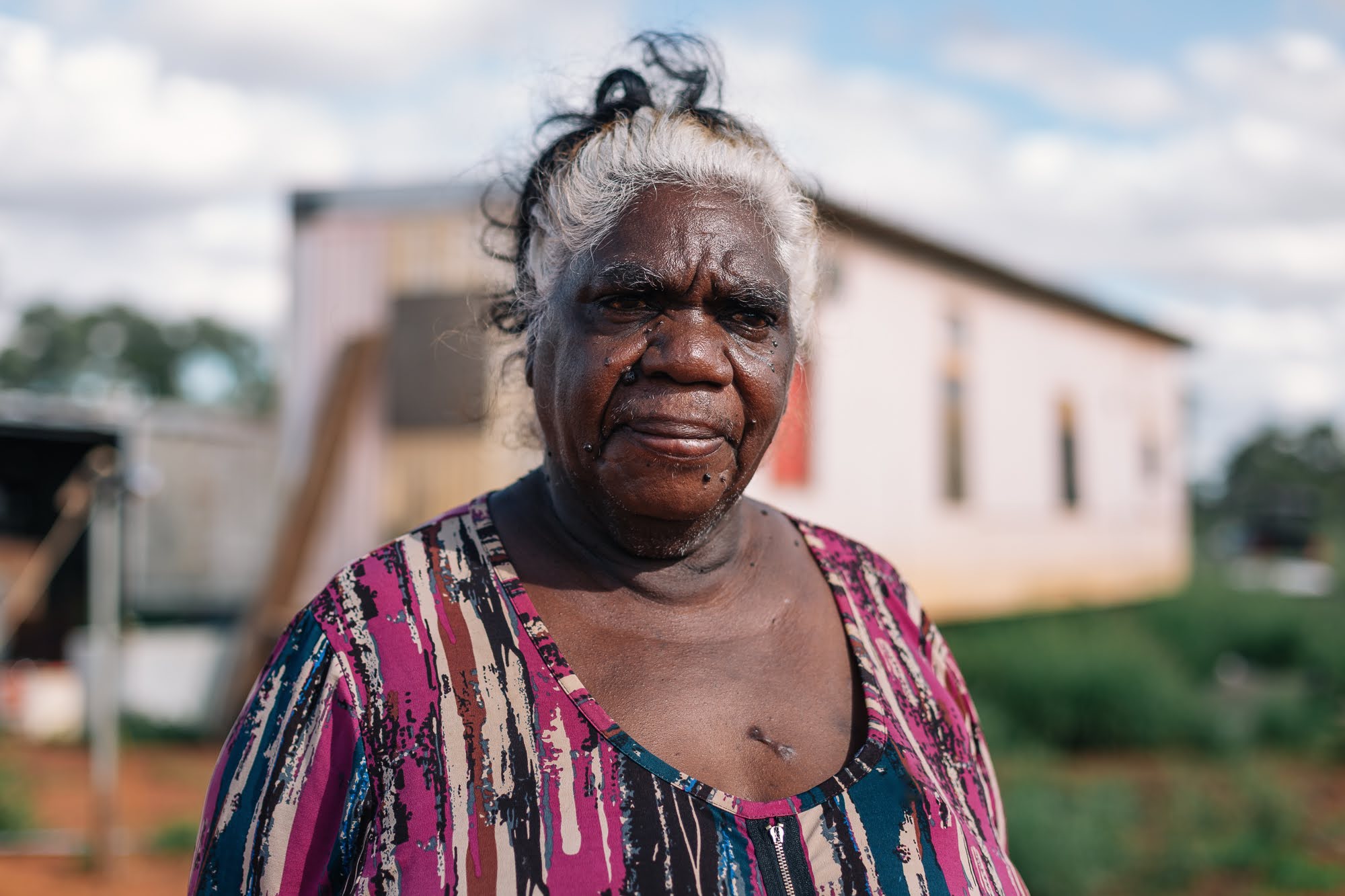
Dianne Stokes
Tennant Creek, Northern Territory, Australia
Dianne Stokes is a devoted traditional owner and guardian of her ancestral lands, living within the boundaries of her totem in a place she's called home for nearly 24 years. Her journey is one of resilience and deep connection to the land, where she initially found shelter under the vast trees, braving the elements with only her car as refuge. Dianne is passionately committed to revitalizing her community, honoring the legacy of her ancestors while fostering a vibrant space for future generations. With a vision to build a cultural and youth center, she aims to provide a nurturing environment for young people, offering them the opportunity to engage in cultural activities and outdoor education. Her unwavering dedication to her community is a testament to her profound love for her country, which calls her back time and again.

Stories like this matter
Help amplify voices from communities that deserve to be heard. Share this story or stay connected for more.